At Connor's suggestion, I'm going to skip ahead to the Vice Lists. But before we do, let me apologize for coming from such a boring direction on the last post. I think that the issue of biblical interpretation is critical to how we continue this discussion, and if we don't agree on some rules about interpreting the text, I'm constantly going to get anonymous commenters accusing me of "bending over backwards to read the meaning I want", or of "ignoring the plain meaning of the scripture." But that last post was kind of a blah way to raise the issue, so maybe we can just deal with it as we go.
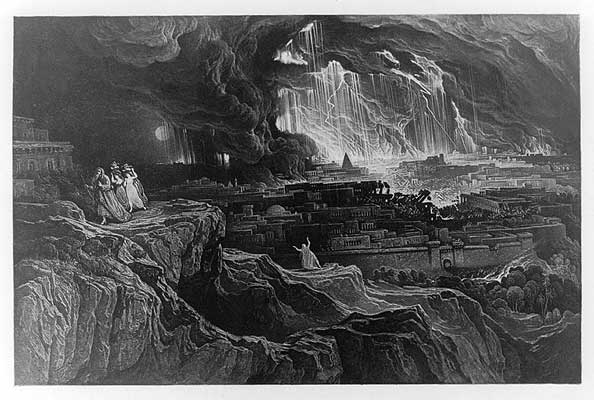
As an update, let's look again at the scriptures that may address homoerotic behavior, and mark off Sodom and Gomorrah, because it just doesn't have any answers to our questions.
The Creation Accounts (Genesis 1 and Genesis 2)
The Holiness Code (Leviticus 18 and 20)
Paul's Theology of Idolatry (Romans 1)
Vice List (1 Corinthians 6)
Vice List (1 Timothy 1)
Today I want to look at the Vice Lists in 1 Corinthians and 1 Timothy.
Most scholars agree that 1 Corinthians was written by Paul. 1 Corinthians wasn't the first letter from Paul to the young church in Corinth; he mentions a previous letter in Chapter 5. Paul spends a lot of time in the letter responding to his Corinthian opponents and discussing how to deal with divisions in the church. The vice list that we're concerned with appears in Chapter 6, where Paul is talking about how to deal with conflicts among church members. Here's an excerpt:
If any of you has a dispute with another, dare he take it before the ungodly for judgment instead of before the saints? Do you not know that the saints will judge the world? And if you are to judge the world, are you not competent to judge trivial cases? Do you not know that we will judge angels? How much more the things of this life! Therefore, if you have disputes about such matters, appoint as judges even men of little account in the church! I say this to shame you. Is it possible that there is nobody among you wise enough to judge a dispute between believers? But instead, one brother goes to law against another — and this in front of unbelievers!
The very fact that you have lawsuits among you means you have been completely defeated already. Why not rather be wronged? Why not rather be cheated? Instead, you yourselves cheat and do wrong, and you do this to your brothers.
Do you not know that the wicked will not inherit the kingdom of God? Do not be deceived: Neither the sexually immoral nor idolaters nor adulterers nor male prostitutes nor homosexual offenders nor thieves nor the greedy nor drunkards nor slanderers nor swindlers will inherit the kingdom of God. And that is what some of you were. But you were washed, you were sanctified, you were justified in the name of the Lord Jesus Christ and by the Spirit of our God.
Ok, let's immediately notice that the first part of the passage is not about homosexual sex, or sex at all. Paul's telling the Corinthians that they need to solve their own disputes rather than take one another to court, and in the kicker of the passage, tells them:
The very fact that you have lawsuits among you means you have been completely defeated already. Why not rather be wronged? Why not rather be cheated? Instead, you yourselves cheat and do wrong, and you do this to your brothers.
Then he reminds them that they are no longer sinners, but saints, and need to start acting like it. He reminds them to be sexually moral, and in the next chapter talks a bit about marriage and what people ought to do about it, because Jesus is obviously coming back in the next couple of years, if not weeks.
First, let's observe that this passage is not about homosexuality; it merely gets an offhand mention. Several authors, including the author of the article I mentioned in the post on Sodom and Gomorrah (Furnish), note that this list of naughty things is a common rhetorical device in period writing. So if this is a standard vice list, we shouldn't assume that Paul is referring to any specific behaviors of any specific person in the Corinthian church. Instead, Paul is simply listing a bunch of things that he thinks are self-evidently bad, as a means of getting to his point, which is, "you shouldn't be doing bad things".
On the other hand, it's possible that Paul is referring to a particular Corinthian behavior. If so, the Greek terms in the passage make it likely that this behavior is sex between men and adolescent male prostitutes. Even scholars who argue that homosexual behavior is sinful recognize this interpretation of the text.
The word malakoi is not a technical term meaning "homosexuals" (no such term existed either in Greek or in Hebrew),but it appears often in Hellenistic Greek as pejorative slang to describe the "passive" partners -- often young boys -- in homosexual activity.
Richard B. Hays, "Awaiting the Redemption of Our bodies: The Witness of Scripture Concerning Homosexuality", in John Carey, ed, The Homosexuality Debate in North American Churches.
In this case, the sinful activity described would include pederasty and prostitution, not consensual homoerotic behavior between committed adult partners. And the vice list in Timothy is even more parenthetical and vague ... the NIV does not even use the word "homosexual".
But no matter whether Paul is being specific or general, it seems clear that the point of these passages is not not the condemnation of consensual homosexual sex. Subsequent chapters in Corinthians talk extensively about morality and marriage -- a place some modern preachers would find perfect for a diatribe against "homosexuality" -- but Paul never mentions it again. And expanding his vague condemnation of gender-bending into a divine fiat against all homoerotic behavior seems to be stepping over some hermeneutical line.
Consequently, I'm going to reach the same conclusion about the Vice Lists that I reached about Sodom and Gomorrah: these passages contain no guidance regarding the morality of consensual homosexual sex. While I think we should at least consider Paul's (Paul's, not the Lord's) opinion about homoerotic behavior, this passge doesn't provide that opinion. Instead, we'll have to look at the passage in Romans, which we'll engage to in a future post.