Societies evolve, and with that evolution comes painful losses with the important gains. Every society, including ours, must learn the trick of what to hold onto and what to let go of. It's not easy. The extreme cultural right is the party of hanging on no matter what; the extreme cultural left is the party of letting go no matter what. Most people live mostly unconsciously in the conflict between the two tendencies, sometimes leaning one way, sometimes the other. Sane people in the middle have to find a way to consciously, artfully synthesize the two tendencies. That's what it means to me to be a centrist--the center is defined by this integrationist project, which is very different from just splitting the difference between the extremes. Integration in this sense is a spiritual activity, but that's a subject for another time.
Tuesday, January 02, 2007
Another blog for you
Jack @ After The Future:

Wednesday, December 20, 2006
Google Zeitgeist
Mark Elrod (I always want to type "Mark Aelrod") posted about Google Zeitgeist earlier today. He just looked at the top searches in 2006, but he seemed to miss some interesting things in the other ratings:
The "where is list":
1. where is togo
2. where is matt
3. where is torino
4. where is darfur
5. where is villanova
6. where is montenegro
7. where is angola
8. where is .com au
9. where is palestine
10. where dubai
Well you can all stop searching. I'm right here.
(BTW, this is probably what they were looking for.)
(Also interesting: For those of you who know my last name, you can search for "where is matt lastname" and find an amazon list that is NOT mine, but looks suspiciously me-ish. If you search for "matthew blog" you will find on page 2 a blog about Matthew at Harding. Also not me.)
The "where is list":
1. where is togo
2. where is matt
3. where is torino
4. where is darfur
5. where is villanova
6. where is montenegro
7. where is angola
8. where is .com au
9. where is palestine
10. where dubai
Well you can all stop searching. I'm right here.
(BTW, this is probably what they were looking for.)
(Also interesting: For those of you who know my last name, you can search for "where is matt lastname" and find an amazon list that is NOT mine, but looks suspiciously me-ish. If you search for "matthew blog" you will find on page 2 a blog about Matthew at Harding. Also not me.)
Tuesday, December 19, 2006
Simplify
It's lunchtime, now. I traipsed through a rare Abilene drizzle to grab Subway's Two for Tuesday, and now I'm sitting at my desk, munching on one of the Two and drawing little boxes and arrows on a sheet of printer paper, three-holed to fit in one of my Very Important three-ring binders.
The boxes and arrows represent different areas of my life - the layout of my home is in one box, the schedule of my week in another - because I'm trying to get things straight. I have this emotionally pressing need to simplify my life. I'm not quite sure what this means, or what the benefits would be, but the feeling is there all the same. My life feels ... cluttered.
Maybe this drive to reduce clutter is one that has arisen from programming, and I'm trying to nest and encapsulate things neatly so that I can hold the entire idea of My Life in my head all at the same time.
Maybe it's about mastery, and I think that if I can reduce the number of entities I encounter on a daily basis - clothes, books, toothbrushes, vehicles, people - I can have more control over my environment.
Or maybe it's that I think that if I could clean up my life, it would be more efficient. I would get more benefit, or be more productive, or something more positive per unit time. Maybe I'm approaching 30 and developing an unsettling, subconscious feeling that I'm wasting my life.
Hm.
I hadn't intended for this post to be about Zen and the Art of Motorcycle Maintenance, but there you go. This bit makes me a bit nervous, if you want to know the truth. Phaedrus goes into the mountains and pretty soon he ends up insane. And if it's all the same, I'd prefer to avoid insane.
Simplify, simplify, simplify.
The boxes and arrows represent different areas of my life - the layout of my home is in one box, the schedule of my week in another - because I'm trying to get things straight. I have this emotionally pressing need to simplify my life. I'm not quite sure what this means, or what the benefits would be, but the feeling is there all the same. My life feels ... cluttered.
Maybe this drive to reduce clutter is one that has arisen from programming, and I'm trying to nest and encapsulate things neatly so that I can hold the entire idea of My Life in my head all at the same time.
Maybe it's about mastery, and I think that if I can reduce the number of entities I encounter on a daily basis - clothes, books, toothbrushes, vehicles, people - I can have more control over my environment.
Or maybe it's that I think that if I could clean up my life, it would be more efficient. I would get more benefit, or be more productive, or something more positive per unit time. Maybe I'm approaching 30 and developing an unsettling, subconscious feeling that I'm wasting my life.
Logic presumes a separation of subject from object; therefore logic is not final wisdom. The illusion of separation of subject from object is best removed by the elimination of physical activity, mental activity and emotional activity. There are many disciplines for this. One of the most important is the Sanskrit dhyana, mispronounced in Chinese as "Chan" and again mispronounced in Japanese as "Zen." Phaedrus never got involved in meditiation because it made no sense to him. In his entire time in India "sense" was always logical consistency and he couldn't find any honest way to abandon this belief. That, I think, was creditable on his part.
But one day in the classroom the professor of philosophy was blithely expounding on the illusory nature of the world for what seemed the fiftieth time and Phaedrus raised his hand and asked coldly if it was believed that the atomic bombs that had dropped on Hiroshima and Nagasaki were illusory. The professor smiled and said yes. That was the end of the exchange.
Within the traditions of Indian philosophy that answer may have been correct, but for Phaedrus and for anyone else who reads newspapers regularly and is concerned with such things as mass destruction of human beings that answer was hopelessly inadequate. He left the classroom, left India and gave up.
He returned to his Midwest, picked up a practical degree of journalism, married, lived in Nevada and Mexico, did odd jobs, worked as a journalist, a science writer and an industrial-advertising writer. He fathered two children, bought a farm and a riding horse and two cars and was starting to put on middle-aged weight. His pursuit of what had been called the ghost of reason had been given up. That's extremely important to understand. He had given up.
Because he'd given up, the surface of life was comfortable for him. He worked reasonably hard, was easy to get along with and, except for an occasional glimpse of inner emptiness shown in some short stories he wrote at the time, his days passed quite usually.
What started him up here into these mountains isn't certain. His wife seems not to know, but I'd guess it was perhaps some of those inner feelings of failure and the hope that somehow this might take him back on the track again. He had become much more mature, as if the abandonment of his inner goals had caused him somehow to age more quickly.
Hm.
I hadn't intended for this post to be about Zen and the Art of Motorcycle Maintenance, but there you go. This bit makes me a bit nervous, if you want to know the truth. Phaedrus goes into the mountains and pretty soon he ends up insane. And if it's all the same, I'd prefer to avoid insane.
Simplify, simplify, simplify.
Thursday, December 14, 2006
Bah, humbug.
 'Convert or die' game divides Christians
I expect you've heard about this game already, but here's some stuff I didn't know:
Left Behind Games' president, Jeffrey Frichner, says the game actually is pacifist because players lose "spirit points" every time they gun down nonbelievers rather than convert them. They can earn spirit points again by having their character pray.
...
Players can choose to join the Antichrist's team, but of course they can never win on Carpathia's side. The enemy team includes fictional rock stars and folks with Muslim-sounding names, while the righteous include gospel singers, missionaries, healers and medics.
...
The Rev. Tim Simpson, a Jacksonville, Fla., Presbyterian minister and president of the Christian Alliance for Progress, added: "So, under the Christmas tree this year for little Johnny is this allegedly Christian video game teaching Johnny to hate and kill?"
Thanks to Colby for the linkage.
I'm going to go hide under the bed now.
Wednesday, December 13, 2006
Zen and the Art: Changing the World
 As I mentioned in an earlier post, I recently read Zen and the Art of Motorcycle Maintenance by Robert Pirsig. A surprising number of people (two) seemed to want to know what I thought of the book. So being the accommodating fellow I am, I'm going to attempt to write about it.
Now this won't be a scholarly literary analysis, or a cliffs note summary, or really any kind of review that any self-respecting publication might be interested in. Instead, I'm simply going to try to describe, in a fairly disorganized way, the sorts of things that happen when the thoughts in my head get mushed together with the thoughts in Zen.
What the book is kind of about
For those of you who haven't read Zen, a brief summary might be in order. Zen really seems to be two books, the first being a narrative about the author taking a cross-country motorcycle trip with his son, with periodic flashbacks discussing the author's life and thinking, all the way up to the point where some mental health experts got ahold of him and solved his various problems by applying choice electrical currents to the appropriate areas of his brain.
The second book, interleaved with the first, is a philosophical investigation of separateness. It's a thoroughly Buddhist attempt to contradict our tendency to reduce, subdivide and compartmentalize the world. In my opinion, this is the meat of the book: the narrative is just a framework for moving the reader along and, at some points, for illustrating the author's philosophy.
An interesting thing
Here's something from Zen that I found interesting:
I think that if we are going to reform the world, and make it a better place to live in, the way to do it is not with talk about relationships of a political nature, which are inevitably dualistic, full of subjects and objects and their relationship to one another; or with programs full of things for other people to do. I think that kind of approach starts it at the end and presumes the end is the beginning. Programs of a political nature are important _end products_ of social quality that can be effective only if the underlying structure of social values is right. The social values are right only if the individual values of[sic] right. The place to improve the world is first in one's own heart and head and hands, and then work outward from there. Other people can talk about how to expand the destiny of mankind. I just want to talk about how to fix a motorcycle. I think that what I have to say has more lasting value.
How should you go about trying to change the world, if you're turned on by that sort of thing?
Pirsig seems to suggest that you're going to get the best results if you focus on improving yourself. And this approach makes a lot of sense: if all the leaves on a tree are green, one's experience of the tree should be green. If all the people in a society are kind, one's experience of the society should be one of kindness.
Then why write a book?
I suppose that one answer would be: you improve yourself to the point where you have something worthwhile to say to other people, and *then* you write your book. Another answer is: "Rob, you're full of crap." If you want to change the world, then bottom-up methods are important, but top-down methods are also good. Writing a book, reforming a government, starting a charity - all of these methods are just as likely to be effective as "make myself a better person".
This poses some problems from a Buddhist point of view: it reinforces my tendency to distinguish between myself and the world. But another problem - a related problem - is that one has to decide what kinds of changes to try to make. And this, I think, is why Pirsig's emphasis on introspection has merit: because effective change does not necessarily equal positive change. If your values are screwed up, then your broad attempts to change the world are likely to screw the world up rather than make it better.
So how do you get good values?
"Good values." Heh.
OK, I'm stuck. Somebody come pull me out.
Tuesday, December 12, 2006
Get wet
Hunh. I guess today's a day for baptism.
From Pastor K at South Bay Christian Church:
And, if you're the audio-visual sermon illustration type, here's yer fix, courtesy of Steve Allison:
From Pastor K at South Bay Christian Church:
Anne Lamott writes that "Christianity is about water. 'Everyone who thirsteth, come ye to the waters.' It's about baptism… It's about full immersion, about falling into something elemental and wet. Most of what we do in worldly life is geared toward our staying dry, looking good, not going under. But in baptism, in lakes and rains and tanks and fonts, you agree to do something that's a little sloppy because at the same time it's also holy, and absurd. It's about surrender, giving into all those things we can't control: it's a willingness to let go of balance and decorum and get drenched."
And, if you're the audio-visual sermon illustration type, here's yer fix, courtesy of Steve Allison:
Tuesday, December 05, 2006
Calling God "He"
 So I'm having a conversation about using gender-neutral language in church, and an acquaintance - a woman - injects this comment:
God is a man. And if he's not a man, well he's sure not a woman.
Props to me: I didn't bite through my tongue.
I consoled myself with the thought that this isn't often an explicit theology: most conservative Christian churches probably hold that God is neither exclusively male nor exclusively female. The problem this presents is that the language most of these churches use to refer to God is exclusively male. And language matters. Because our language is currently at odds with our theology, we need to change one or the other.
One of the objections I hear for changing from masculine language is, "what are you going to use instead?" Specifically, the questioner usually wants to know what I am going to use as the singular pronoun when referring to God. So in a sentence like this:
God is good, and he wants us to be good.
they want to know, what am I going to use to replace "he?"
At first glance, this is a significant problem, because the English language has no gender-neutral singular personal pronoun.
"She" is not a good alternative, because it causes the same problems as "he". (Although one could argue for a sort of linguistic affirmative action, wherein we should call God "she" for the next several thousand years to make up for always having called God "he" before.)
Likewise, "it" is out of the question, because most of these people believe in a personal God, and calling a person "it" is degrading. (Although one could argue that calling a person "she" is also degrading.)
But the obvious answer, which sometimes gets overlooked, is: don't use a pronoun.
God is good, and God wants us to be good
Problem solved.
But won't this be cumbersome? Won't it sound really awkward?
Well, do the things said about God on this blog sound awkward? Because this is the language I already use, both in writing and speaking. It's what I've done for several years. And to my knowledge, nobody's noticed.
Sadly, this doesn't entirely solve our language problems, and here are two reasons:
1. Songs. It's hard to change them to be gender neutral, and not butcher them. (Gender-equal, maybe, but not gender neutral.) I'm sure you could come up with many more examples, but how would you reword these songs:
Dear Lord and Father of mankind
Forgive our foolish ways...
O worship the King
All glorious above
And gratefully sing
His wonderful love...
2. Gender-neutral language may not go far enough. Exploring God in the context of ideas that we have traditionally labeled "female" could be very powerful, but this is stymied somewhat by going to gender neutrality. In more conservative churches, though, going to even occasionally female language would be even harder than going to neutral language ... as you can see by the quote at the top of this post.
Friday, December 01, 2006
Zen and the Art of Motorcycle Maintenance
One reason I haven't been posting: I've been reading, and it's hard for me to do both at the same time.
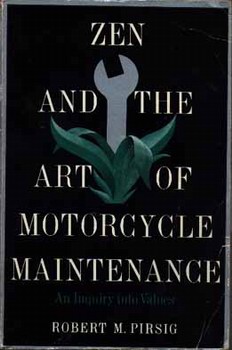
One of the books I finished recently: Zen and the Art of Motorcycle Maintenance, by Robert M. Pirsig. I may have more to say about the book later; for now, here's an excerpt.
One of the books I finished recently: Zen and the Art of Motorcycle Maintenance, by Robert M. Pirsig. I may have more to say about the book later; for now, here's an excerpt.
The ugliness the Sutherlands were fleeing is not inherent in technology. It only seemed that way to them because it's so hard to isolate what it is within technology that's so ugly. But technology is simply the making of things and the making of things can't by its own nature be ugly or there would be no possibility for beauty in the arts, which also include the making of things. Actually a root word of technology, techne, originally meant "art." The ancient Greeks never separated art from manufacture in their minds, and so never developed separate words for them.
Neither is the ugliness inherent in the materials of modern technology – a statement you sometimes hear. Mass-produced plastics and synthetics aren't in themselves bad. They've just acquired bad associations. A person who's lived inside stone walls of a prison most of his life is likely to see stone as an inherently ugly material, even though it's also the prime material of sculpture, and a person who's lived in a prison of ugly plastic technology that started with his childhood toys and continues through a lifetime of junky consumer products is likely to see this material as inherently ugly. But the real ugliness of modern technology isn't found in any material or shape or act or product. These are just the objects in which the low Quality appears to reside. It's our habit of assigning Quality to subjects or objects that gives this impression.
The real ugliness is not the result of any objects of technology. Nor is it, if one follows Phaedrus' metaphysics, the result of any subjects of technology, the people who produce it or the people who use it. Quality, or its absence, doesn't reside in either the subject or the object. The real ugliness lies in the relationship between the people who produce the technology and the things they produce, which results in a similar relationship between the people who use the technology and the things they use ...
The result is rather typical of modern technology, an overall dullness of appearance so depressing that it must be overlaid with a veneer of "style" to make it acceptable. And that, to anyone who is sensitive to romantic Quality, just makes it all the worse. Now it's not just depressingly dull, it's also phony. Put the two together and you get a pretty accurate basic description of modern American technology: stylized cars and stylized outboard motors and stylized typewriters and stylized clothes. Stylized refrigerators filled with stylized food in stylized kitchens in stylized homes. Plastic stylized toys for stylized children, who at Christmas and birthdays are in style with their stylish parents. You have to be awfully stylish yourself not to get sick of it once in a while. It's the style that gets you; technological ugliness syruped over with romantic phoniness in an effort to produce beauty and profit by people who, though stylish, don't know where to start because no one has ever told them there's such a thing as Quality in the world and it's real, not style. Quality isn't something you lay on top of subjects and objects like tinsel on a Christmas tree. Real Quality must be the source of subjects and objects, the cone from which the tree must start.
Saturday, November 11, 2006
Out to Lunch
 I'll be away for a week or two.
Don't do anything fun while I'm gone, 'k?
Update: I'm back.
(So among all those people who share my warped idea of fun, let there be much rejoicing.)
Wednesday, November 08, 2006
So... close...
 Barring any legal hijinks by the Republicans, it looks like the Democrats are going to pick up both the House and the Senate.
w00t?
As far as I can tell, CNN has the best online coverage of the election results. They're also carrying some interesting exit poll data. For example, here's a snippet from their U.S. HOUSE SOUTH EXIT POLL:
VOTE BY RELIGION
| Democrat | Republican | |
| Protestant (70%) | 42% | 57% |
VOTE BY RELIGION AMONG WHITES
| Democrat | Republican | |
| White Protestants (54%) | 32% | 66% |
BORN-AGAIN OR EVANGELICAL CHRISTIAN?
| Democrat | Republican | |
| Yes (49%) | 41% | 58% |
WHITE EVANGELICAL/BORN-AGAIN?
| Democrat | Republican | |
| Yes (35%) | 28% | 71% |
Well allrighty.
Tuesday, November 07, 2006
Vote.
Unless you're stupid. Then stay home.
Bonus election day link! Leonard Pitts Jr. sums up my opinion about the Democratic Party.
Bonus election day link! Leonard Pitts Jr. sums up my opinion about the Democratic Party.
Monday, November 06, 2006
Richard Beck's Universalism posts
In Christian theology, Universalism is the idea that all people will be saved.
I had been considering a couple of posts about universalism, but lo and behold, Dr. Richard Beck has already done a brief series on why he's a universalist. I'll start by linking you there, and maybe later I'll have some things to add.
Why I am a Universalist
I think my favorite post in the bunch is this one, which juxtaposes Universalism, Calvinism and Arminianism. An excerpt:
I had been considering a couple of posts about universalism, but lo and behold, Dr. Richard Beck has already done a brief series on why he's a universalist. I'll start by linking you there, and maybe later I'll have some things to add.
Why I am a Universalist
I think my favorite post in the bunch is this one, which juxtaposes Universalism, Calvinism and Arminianism. An excerpt:
Talbott in Universal Salvation? asks us to consider three theological propositions:
1. God’s redemptive love extends to all human sinners equally in the sense that he sincerely wills or desires the redemption of each one of them.
2. Because no one can finally defeat God’s redemptive love or resist it forever, God will triumph in the end and successfully accomplish the redemption of everyone whose redemption he sincerely wills or desires.
3. Some human sinners will never be redeemed but will instead be separated from God forever.
First, it should be noted that significant Biblical support could be cited for each proposition. All are supported by the biblical witness.
However, and here's the rub, Talbott points out that these propositions are logically inconsistent. That is, a Christian cannot, logically, endorse all three propositions. Look back over the propositions and mull them over. You'll see he has a point.
Thursday, October 26, 2006
Confession 2
 Background:
Sometimes, crafty church gnomes place blatantly partisan literature in our church foyer. The latest brochure was a glossy little voting guide, but the local, jingoistic, "christian" "newspaper" makes regular appearances as well.
Confession:
When nobody's looking, I extract the newspapers from the foyer, and add them to a neat little stack in the utility closet.
Underhanded, I know, but I figure this causes fewer problems than demanding equal space for a stack of Planned Parenthood brochures.
Tuesday, October 24, 2006
Engaging the Text
A series of posts on what the biblical text might have to say about the morality of homoerotic behavior.
(Note: This post is a trailhead. None of these posts are new, but a trailhead post makes it easy to add a link to the series in my sidebar.)
Hm. Now that I look at it, I skipped the holiness codes in Leviticus. Ok, give me a minute ... ah, here we go:

Also, remember that you're not allowed to wear the devil's own fabric, polyester. Maybe because it's fire-retardant? I dunno.
(Note: This post is a trailhead. None of these posts are new, but a trailhead post makes it easy to add a link to the series in my sidebar.)
- Overview
- Sodom and Gomorrah
- An Interlude
- The Vice Lists
- Paul's Theology in Romans
- Stuff about God
- What Romans 1 Says about God
- Ethics and Romans 1
Hm. Now that I look at it, I skipped the holiness codes in Leviticus. Ok, give me a minute ... ah, here we go:

Also, remember that you're not allowed to wear the devil's own fabric, polyester. Maybe because it's fire-retardant? I dunno.
Thursday, October 19, 2006
Hope
 "Odd," I thought. "I wasn't expecting this feeling."
But there it was anyhow, in the middle of an otherwise uninspiring paragraph about feminisim, atonement, and Jesus.
I had been meandering through a book my sister gave me for my birthday, trying to nudge the scattered bits of my feminism into something coherent, toting my theological briefcase, very businesslike, and then this old friend recognized me, leapt on me, overwhelmed me with an embrace that was more than half wrestling hold.
"Wow," I thought. "I remember this feeling."
It feels like hope, but it's not quiet, or rosy.
Instead, it's a firework that hits me in the eyes and the gut at the same time, occupying my mind's eye so fully that, for a long ecstatic moment, I'm blind to everything but that one unavoidable future, largely featuring the triumph of laughter, full of mountains, of warm days smelling like watermelon and feeling like river water, chilly days feeling like friends and smelling like warm coffee, everything limned in golden joy.
And although the feeling quickly fades, for the moment I am convinced. There really is hope for the world, and there really is power in the cross of Christ. It is a power we can trust and admire: not the power to live perfectly, or the power to appease a transcendent, merciless, bloodthirsty God, but the deep affection that seems to be the only way to transform hatred without fostering hatred, to eradicate violence without using force, and to grant joyful life despite the power of death.
Friday, October 13, 2006
Happy birthday to me!
In keeping with my longstanding tradition of throwing birthday parties for myself: today is my birthday! Happy birthday to me!

Here's a fun game: If you want to get me a gift, don't buy anything ... just copy the internet address from your browser and paste it into a comment. So, for example, you could put your favorite book from Amazon.com, or maybe your favorite video from YouTube. After you submit the comment, I'll put a picture of your gift at the bottom of this post.
Fun!
Happy birthday to me!
(from Crystal)
(from Colby)

(from Jeff)
(from The Cute One)
(from Connor)
(from Scoots)

(from Stu. NSFW!)

(from Sandy)

(from Jessica)

(from Casey)

Here's a fun game: If you want to get me a gift, don't buy anything ... just copy the internet address from your browser and paste it into a comment. So, for example, you could put your favorite book from Amazon.com, or maybe your favorite video from YouTube. After you submit the comment, I'll put a picture of your gift at the bottom of this post.
Fun!
Happy birthday to me!
(from Crystal)
(from Colby)
(from Jeff)
(from The Cute One)
(from Connor)
(from Scoots)
(from Stu. NSFW!)
(from Sandy)
(from Jessica)

(from Casey)
Tuesday, October 10, 2006
Great Britain held hostage by ... Harding?
OK, I feel bad about all this off-site linking - it makes me feel like a lazy blogger - but you ACU and Harding folks shouldn't miss this one. It seems that Harding's new missions globe has ... um ... misplaced Great Britain by a few thousand miles.

No wonder those Brits are post-Christian! We obviously can't find them so that they can be re-evangelized!
Click the image to visit the Lame-O Weblog of Mark Elrod, who teaches at Harding.
And speaking of Mark Elrod, does anybody know an ACU professor who has a blog, much less a blog as interesting as Elrod's?
Update:
Mark reports that Great Britain has been returned to its rightful place. Whew. That was fixed rather quickly, though. I wonder ... how easy is it to move those continents around?
Also, Colby suggests reading the blog of (ACU Associate Professor) Richard Beck.
No wonder those Brits are post-Christian! We obviously can't find them so that they can be re-evangelized!
Click the image to visit the Lame-O Weblog of Mark Elrod, who teaches at Harding.
And speaking of Mark Elrod, does anybody know an ACU professor who has a blog, much less a blog as interesting as Elrod's?
Update:
Mark reports that Great Britain has been returned to its rightful place. Whew. That was fixed rather quickly, though. I wonder ... how easy is it to move those continents around?
Also, Colby suggests reading the blog of (ACU Associate Professor) Richard Beck.
Monday, October 09, 2006
Two wars
As I was walking down the hall this morning, I suddenly realized: During the first four years of the Bush presidency, the United States invaded not one, but two sovereign nations and initiated two wars.
Two wars in four years.
And instead of ousting the people responsible, we voted to give them another four years. More than 40,000 civilians have been killed in Iraq alone.

I think I'll go be sick now.
Two wars in four years.
And instead of ousting the people responsible, we voted to give them another four years. More than 40,000 civilians have been killed in Iraq alone.

I think I'll go be sick now.
Sunday, October 01, 2006
Church of Christ vs Episcopal Church
Connor has attended both, and provides you with this deep and meaningful analysis.
Go, read, now!
Update: It would help if I actually put the link in...
Praying:
CoC - Kneel if you want to be stared at.
EC - Kneel or die.
Go, read, now!
Update: It would help if I actually put the link in...
Thursday, September 28, 2006
Class update
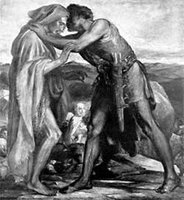 OK, Connor requested a class update, so here it is.
We've spent the last three weeks talking about Genesis 1-3, and what it may or may not have to do with gender roles. I mean, we still haven't taken the five minutes we would need to define the terms "sex" and "gender", and consequently, people frequently say interesting things like, "Yes, I think Adam and Eve probably had sex ... um ... gender."
But moving on...
Like I said before, the class is tag-team-taught by Shane and another guy (Damon). After being in the class for several weeks, I can say that they've done a pretty good job of picking a direction and sticking with it. If I've understood their approach correctly, they're basically trying do apologetics for the creation narratives.
Shane has a sort of literary approach to the text, where you classify its genre and then you only listen to the messages you would expect to hear coming out of that genre. Damon has a sort of Rabbinical approach to the text, which means you try to tease out a lot of allegory and hidden meaning. But basically, both of them are doing a lot of work trying to get the students to interpret Genesis in a new way, and then, kind of parenthetically, following that up by arguing that Genesis talks about identity but not so much about gender roles.
I think this approach is pretty good. It makes the class of mostly college students stretch a little bit, and tweak their hermeneutic, and even reconsider their gender biases, but it doesn't require them to do anything terribly scary or off-putting. All in all, I think the students are going to come out of this class with a better way of reading the first 3 chapters of Genesis, and a little more play in their ideas about gender.
But I do think the teachers are a little reluctant to address certain issues, including
- What modern psychology says about gender
- What feminists say about gender
- The church's sins against women
- Why homosexuality is a gender issue
Maybe we'll get to these as we go along. At any rate, I'm hoping that before we get out of Genesis, we at least look at Jacob and Esau.
Subscribe to:
Posts (Atom)
