The pair of images is from a series of monsters drawn by children and continued by artists. h/t colby.
I am myself, a single, whole entity, having only one physical manifestation and occupying only a set length of time, having only one soul, whose destiny is unique. Yet I am myself a plurality, made of various, uncertainly connected, discrete parts.
For I am made of emotions that bow to various masters, of thoughts born from various progenitors, of opinions that have grown from, are growing from, or have yet to grow from seeds sown by various cultivators.
My heart cannot be said to be one to give to one, for it is free for the tearing to many, who may hate me, who may love me, who may never have even imagined my existence.
I am not of a uniform, singular, or unique spirit, being prone to mercurial changes in tone of mind and direction of purpose.
Bearing all this in mind, then, though I am but one person, in what way, exactly, am I an individual?
 I've been tagged with the "thinking blogger" award-slash-meme by Paul and Richard. (Richard thinks it started here.) I am supposed to respond by naming five bloggers who make me think. I'll go ahead and start with ... Paul and Richard:
1. Original Faith is Paul Martin's blog. Paul knows about interesting things like belief, psychology, and being really ill. Also, He's a bit of a poet. I like that about him.
2. Experimental Theology is Richard Beck's blog. Richard is a philosophy professor at my alma mater, Abilene Christian University, and shares my peculiar religious tradition. He knows about interesting things like genes, psychology, and speakeasies in New Orleans. He plugged me as "one of the few people I know who might be more heretical than I am". I like that about him.
Here are six other bloggers who make me think. I need to do extra because I don't want a real "blogroll" on my sidebar, and I feel bad about it sometimes. This is my way of expurgating that guilt. I'm glad you can all help me out.
3. Douglas Muder is a Unitarian Universalist, who once upon a time gently thumped me down because I said he had written a book he hadn't written. He's not a frequent poster, but he occasionally drops some good stuff at Free and Responsible Search.
4. Jack Whelan and Crystal are both Catholic, so I'm cheating and squeezing them into one slot. Jack's blog, After the Future, is primarily political, with a little touch of Catholic theology thrown in occasionally to spice things up. Crystal's blog, Perspective, is probably the most personal blog that I read, and has lots of Catholic theology with the occasional sci-fi movie review thrown in to spice things up.
5. Scoots is a Ph.D. student at Boston College, which happens to be in Boston. Scoots is a contrarian in a sea of liberals, just like I'm a contrarian in a sea of conservatives, so his posts tend to be a little conservative. His almost-eponymous blog tends to talk about things like the Bible and songs by Rich Mullins. But it's pretty good anyway.
6. Joel Spolsky, at Joel on Software, writes mostly about software development, but a lot of his insights apply to entrepreneurship in general. He used to work for Microsoft, started his own software company and wrote a couple of books, and has since ascended to the status of demigod in the programming community. I think this might have something to do with the fact that he says things like, "programmers should not be farmed in cubicles, but should have their own private offices with doors." I could be way off base, though.
7. Pastor Katherine preaches at South Bay Christian Church of Redondo Beach, which should make you deeply jealous. Her Sermon Blog is here, and she mostly keeps it updated. On a fairly regular basis, Pastor K's sermons manage to be triumphant without being cotton-candy. That's pretty sweet.

Would we understand a panentheistic God as having created the cosmos, i.e., with some form of intention? Because if we don't, then we still need some explanation for why there's a universe, and if we do then that god would still bear culpability for making a world where horrors would take place.
 Next, Connor and Jennifer hand us this question regarding the God described in the previous posts.
What about him is compelling, or inspires you to worship or follow him?
"The God who made the world and everything in it is the Lord of heaven and earth and does not live in temples built by hands. And he is not served by human hands, as if he needed anything, because he himself gives all men life and breath and everything else. From one man he made every nation of men, that they should inhabit the whole earth; and he determined the times set for them and the exact places where they should live. God did this so that men would seek him and perhaps reach out for him and find him, though he is not far from each one of us. 'For in him we live and move and have our being.' As some of your own poets have said, 'We are his offspring.'

You could reject special providence, but I find it hard to reject the special providence if you're going to hold that the Scriptures contain anything that resembles truth regarding the nature of God
"Have you allowed all the women to live?" he asked them. "They were the ones who followed Balaam's advice and were the means of turning the Israelites away from the LORD in what happened at Peor, so that a plague struck the LORD's people. Now kill all the boys. And kill every woman who has slept with a man, but save for yourselves every girl who has never slept with a man."
And the LORD was displeased with Moses for his lecherous and genocidal counsel, and struck him dead on the spot.
The LORD said to Moses, "You and Eleazar the priest and the family heads of the community are to count all the people and animals that were captured. Divide the spoils between the soldiers who took part in the battle and the rest of the community."
...
The plunder remaining from the spoils that the soldiers took was 675,000 sheep, 72,000 cattle, 61,000 donkeys and 32,000 women who had never slept with a man.

Could you say a little more about dropping special providence, but sticking with God is good. It seems to me that most people, at least at the gut level, claim God to be good because of special providence, i.e. Jesus (as God) dies for my sins so I'm saved, yanks me out of Egypt, whatever.

 Woah.
Woah.The encounter with the Christ is an experience of insemination in the Matthew 13 sense (parable of sower, mustard seed, etc.). This seed has a subversive effect within the soul life of those who are inseminated, and they find that if they nurture its germination in the right way, a new regime grows within.
 I've written a little lately about books I've been reading, but what about the books I haven't been reading? Specifically, what about the book my wife is reading about Chinese Christians in the early 1980's, The Heavenly Man?
 So a few of us are up at the church building this morning, getting lunch ready. Woman walks in and tells me about how she got jumped at the bus station. Shows me her broken glasses. Tells me how the nice bus people reinstated her ticket, thank the Lord, but now she needs some help for the trip to Dallas.
 Just so you don't miss it, the President is supposed to address the nation tonight at 8 p.m. Central (GMT -6) regarding his proposal for increasing the number of U.S. troops in Iraq. Democrats in congress have already started advancing legislation that would require authorization for any such surge.
Societies evolve, and with that evolution comes painful losses with the important gains. Every society, including ours, must learn the trick of what to hold onto and what to let go of. It's not easy. The extreme cultural right is the party of hanging on no matter what; the extreme cultural left is the party of letting go no matter what. Most people live mostly unconsciously in the conflict between the two tendencies, sometimes leaning one way, sometimes the other. Sane people in the middle have to find a way to consciously, artfully synthesize the two tendencies. That's what it means to me to be a centrist--the center is defined by this integrationist project, which is very different from just splitting the difference between the extremes. Integration in this sense is a spiritual activity, but that's a subject for another time.
Logic presumes a separation of subject from object; therefore logic is not final wisdom. The illusion of separation of subject from object is best removed by the elimination of physical activity, mental activity and emotional activity. There are many disciplines for this. One of the most important is the Sanskrit dhyana, mispronounced in Chinese as "Chan" and again mispronounced in Japanese as "Zen." Phaedrus never got involved in meditiation because it made no sense to him. In his entire time in India "sense" was always logical consistency and he couldn't find any honest way to abandon this belief. That, I think, was creditable on his part.
But one day in the classroom the professor of philosophy was blithely expounding on the illusory nature of the world for what seemed the fiftieth time and Phaedrus raised his hand and asked coldly if it was believed that the atomic bombs that had dropped on Hiroshima and Nagasaki were illusory. The professor smiled and said yes. That was the end of the exchange.
Within the traditions of Indian philosophy that answer may have been correct, but for Phaedrus and for anyone else who reads newspapers regularly and is concerned with such things as mass destruction of human beings that answer was hopelessly inadequate. He left the classroom, left India and gave up.
He returned to his Midwest, picked up a practical degree of journalism, married, lived in Nevada and Mexico, did odd jobs, worked as a journalist, a science writer and an industrial-advertising writer. He fathered two children, bought a farm and a riding horse and two cars and was starting to put on middle-aged weight. His pursuit of what had been called the ghost of reason had been given up. That's extremely important to understand. He had given up.
Because he'd given up, the surface of life was comfortable for him. He worked reasonably hard, was easy to get along with and, except for an occasional glimpse of inner emptiness shown in some short stories he wrote at the time, his days passed quite usually.
What started him up here into these mountains isn't certain. His wife seems not to know, but I'd guess it was perhaps some of those inner feelings of failure and the hope that somehow this might take him back on the track again. He had become much more mature, as if the abandonment of his inner goals had caused him somehow to age more quickly.
 'Convert or die' game divides Christians
Left Behind Games' president, Jeffrey Frichner, says the game actually is pacifist because players lose "spirit points" every time they gun down nonbelievers rather than convert them. They can earn spirit points again by having their character pray.
...
Players can choose to join the Antichrist's team, but of course they can never win on Carpathia's side. The enemy team includes fictional rock stars and folks with Muslim-sounding names, while the righteous include gospel singers, missionaries, healers and medics.
...
The Rev. Tim Simpson, a Jacksonville, Fla., Presbyterian minister and president of the Christian Alliance for Progress, added: "So, under the Christmas tree this year for little Johnny is this allegedly Christian video game teaching Johnny to hate and kill?"
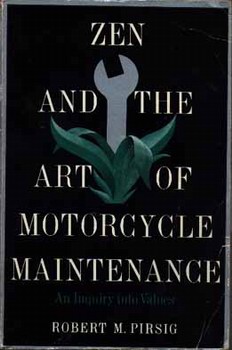
 As I mentioned in an earlier post, I recently read Zen and the Art of Motorcycle Maintenance by Robert Pirsig. A surprising number of people (two) seemed to want to know what I thought of the book. So being the accommodating fellow I am, I'm going to attempt to write about it.
I think that if we are going to reform the world, and make it a better place to live in, the way to do it is not with talk about relationships of a political nature, which are inevitably dualistic, full of subjects and objects and their relationship to one another; or with programs full of things for other people to do. I think that kind of approach starts it at the end and presumes the end is the beginning. Programs of a political nature are important _end products_ of social quality that can be effective only if the underlying structure of social values is right. The social values are right only if the individual values of[sic] right. The place to improve the world is first in one's own heart and head and hands, and then work outward from there. Other people can talk about how to expand the destiny of mankind. I just want to talk about how to fix a motorcycle. I think that what I have to say has more lasting value.
Anne Lamott writes that "Christianity is about water. 'Everyone who thirsteth, come ye to the waters.' It's about baptism… It's about full immersion, about falling into something elemental and wet. Most of what we do in worldly life is geared toward our staying dry, looking good, not going under. But in baptism, in lakes and rains and tanks and fonts, you agree to do something that's a little sloppy because at the same time it's also holy, and absurd. It's about surrender, giving into all those things we can't control: it's a willingness to let go of balance and decorum and get drenched."
 So I'm having a conversation about using gender-neutral language in church, and an acquaintance - a woman - injects this comment:
God is a man. And if he's not a man, well he's sure not a woman.
God is good, and he wants us to be good.
God is good, and God wants us to be good
The ugliness the Sutherlands were fleeing is not inherent in technology. It only seemed that way to them because it's so hard to isolate what it is within technology that's so ugly. But technology is simply the making of things and the making of things can't by its own nature be ugly or there would be no possibility for beauty in the arts, which also include the making of things. Actually a root word of technology, techne, originally meant "art." The ancient Greeks never separated art from manufacture in their minds, and so never developed separate words for them.
Neither is the ugliness inherent in the materials of modern technology – a statement you sometimes hear. Mass-produced plastics and synthetics aren't in themselves bad. They've just acquired bad associations. A person who's lived inside stone walls of a prison most of his life is likely to see stone as an inherently ugly material, even though it's also the prime material of sculpture, and a person who's lived in a prison of ugly plastic technology that started with his childhood toys and continues through a lifetime of junky consumer products is likely to see this material as inherently ugly. But the real ugliness of modern technology isn't found in any material or shape or act or product. These are just the objects in which the low Quality appears to reside. It's our habit of assigning Quality to subjects or objects that gives this impression.
The real ugliness is not the result of any objects of technology. Nor is it, if one follows Phaedrus' metaphysics, the result of any subjects of technology, the people who produce it or the people who use it. Quality, or its absence, doesn't reside in either the subject or the object. The real ugliness lies in the relationship between the people who produce the technology and the things they produce, which results in a similar relationship between the people who use the technology and the things they use ...
The result is rather typical of modern technology, an overall dullness of appearance so depressing that it must be overlaid with a veneer of "style" to make it acceptable. And that, to anyone who is sensitive to romantic Quality, just makes it all the worse. Now it's not just depressingly dull, it's also phony. Put the two together and you get a pretty accurate basic description of modern American technology: stylized cars and stylized outboard motors and stylized typewriters and stylized clothes. Stylized refrigerators filled with stylized food in stylized kitchens in stylized homes. Plastic stylized toys for stylized children, who at Christmas and birthdays are in style with their stylish parents. You have to be awfully stylish yourself not to get sick of it once in a while. It's the style that gets you; technological ugliness syruped over with romantic phoniness in an effort to produce beauty and profit by people who, though stylish, don't know where to start because no one has ever told them there's such a thing as Quality in the world and it's real, not style. Quality isn't something you lay on top of subjects and objects like tinsel on a Christmas tree. Real Quality must be the source of subjects and objects, the cone from which the tree must start.
 I'll be away for a week or two.
 Barring any legal hijinks by the Republicans, it looks like the Democrats are going to pick up both the House and the Senate.
| Democrat | Republican | |
| Protestant (70%) | 42% | 57% |
| Democrat | Republican | |
| White Protestants (54%) | 32% | 66% |
| Democrat | Republican | |
| Yes (49%) | 41% | 58% |
| Democrat | Republican | |
| Yes (35%) | 28% | 71% |
Talbott in Universal Salvation? asks us to consider three theological propositions:
1. God’s redemptive love extends to all human sinners equally in the sense that he sincerely wills or desires the redemption of each one of them.
2. Because no one can finally defeat God’s redemptive love or resist it forever, God will triumph in the end and successfully accomplish the redemption of everyone whose redemption he sincerely wills or desires.
3. Some human sinners will never be redeemed but will instead be separated from God forever.
First, it should be noted that significant Biblical support could be cited for each proposition. All are supported by the biblical witness.
However, and here's the rub, Talbott points out that these propositions are logically inconsistent. That is, a Christian cannot, logically, endorse all three propositions. Look back over the propositions and mull them over. You'll see he has a point.
 Background:
 "Odd," I thought. "I wasn't expecting this feeling."








Praying:
CoC - Kneel if you want to be stared at.
EC - Kneel or die.
 OK, Connor requested a class update, so here it is.
 OK, since a lot of you seem to be interested in gender and Genesis and all that, let's continue our discussion with a new post. There seem to be several questions that people are interested in answering, which I will summarize as follows:
The decision to send the loyal and the willing instead of the best and the brightest is now regarded by many people involved in the 3 1/2 -year effort to stabilize and rebuild Iraq as one of the Bush administration's gravest errors. Many of those selected because of their political fidelity spent their time trying to impose a conservative agenda on the postwar occupation, which sidetracked more important reconstruction efforts and squandered goodwill among the Iraqi people, according to many people who participated in the reconstruction effort.
 Gosh, I suck at public speaking.
Bla bla bla nurturing bla gay men bla bla.
"these attempts can span almost the entire spectrum of religious sensibility: they can be cold with Stoical austerity, moist with lachrymose piety, wanly roseate with sickly metaphysical optimism."

Here, Jesus spoke with the Samaritan woman in exactly the same manner as he spoke with Nicodemus. He showed the same degree of seriousness, the same concern to lead both to deeper insights, and the same perception as to where they each were in their own spiritual development ... to this Samaritan woman, Jesus chose to begin to reveal the reality of the Spirit, which even Jesus’ closest disciples did not fully understand until years later.
In the Gospel of John, it is to this Samaritan woman that Jesus chose first to affirm his identity as Messiah. He found in her an openness and a level of understanding that suggested that such a revelation to her could be fruitful. She in turn led others of her town to listen to Jesus and to come to believe in him as the Christ. Thus, remarkably, the Gospel of John suggests that the first real community of believers in Jesus was among the Samaritans, led to their own personal faith (though they were reluctant to admit it) by this Samaritan woman (John 4:39-42)