But it may turn out to be entertaining.
Will Blog for Food
Update: Nevermind.
Friday, August 15, 2008

Wednesday, June 04, 2008
Some Obama Things
In case you hadn't heard, Obama seems to have enough delegates to claim the Democratic presidental nomination. Yay. =)
Also a friend sent me a link to this deep and meaningful article about why Obama isn't a Christian. My immediate reaction is that it's fine and good if Cal Thomas wants to say Obama isn't a Christian, so long as he notices that he's not a Christian either, since he obviously worships the Bible instead of ... y'know ... God.
Also a friend sent me a link to this deep and meaningful article about why Obama isn't a Christian. My immediate reaction is that it's fine and good if Cal Thomas wants to say Obama isn't a Christian, so long as he notices that he's not a Christian either, since he obviously worships the Bible instead of ... y'know ... God.
Sunday, May 25, 2008
My Summer Vacation
Well, OK, Spring Vacation.
For the last month and a half or so, I've been giving Google Reader a rest. I haven't read any news feeds or blog posts, and I haven't posted much of anything here. So if you were wondering whether I had fallen off the face of the Internets, I guess the answer would be yes.
I'm not sure why I've unplugged to this degree ... maybe it's my debugging instinct kicking in, turning things off one at a time to try and find out which ones improve my life and which ones degrade it. Still working on that task.
Anyhow, I apologize for the somewhat narcissistic thread that I perceive to be woven through this blog. I prefer to talk less about my particular life and more about ideas and happenings. But thank you to those of you who have shown an interest in my personal thoughts and situation. It is a pleasant way to be loved.
And since I've started down that path, I suppose it wouldn't hurt to ask for a little more help. If you recall, when I posted my post about taking a break from church, I mentioned that one of the things I was looking for was a new mentor or group of mentors. Not that there weren't virtuous people at church, but the virtues they exhibited weren't really the ones I wanted to acquire. Recently, I made a list of virtues that I would like to learn, which looked about like this:
I can think of several ways to go about pursuing these qualities, but I'm curious about where you have learned them. I know quite a few of you have experience with particular disciplines such as fasting, prayer and meditation, 'spiritual exercises' and the like. How have those formed you?
I expect habit formation to be an important part (maybe the entirety) of virtue formation, so if you find yourself (or maybe a friend of yours) to have some of these virtues, how did you (or they) develop them?
There also seems to be this conventional wisdom that virtue is best learned within a community of people seeking the same virtues. Well, the American transcendentalists might disagree, but for the sake of argument ... what communities have you experienced that contain an inordinately large number of people who exhibit these virtues?
Or if this more specific question is easier, try answering it instead: If you could recommend that I do one thing different today, what would it be?
For the last month and a half or so, I've been giving Google Reader a rest. I haven't read any news feeds or blog posts, and I haven't posted much of anything here. So if you were wondering whether I had fallen off the face of the Internets, I guess the answer would be yes.
I'm not sure why I've unplugged to this degree ... maybe it's my debugging instinct kicking in, turning things off one at a time to try and find out which ones improve my life and which ones degrade it. Still working on that task.
Anyhow, I apologize for the somewhat narcissistic thread that I perceive to be woven through this blog. I prefer to talk less about my particular life and more about ideas and happenings. But thank you to those of you who have shown an interest in my personal thoughts and situation. It is a pleasant way to be loved.
And since I've started down that path, I suppose it wouldn't hurt to ask for a little more help. If you recall, when I posted my post about taking a break from church, I mentioned that one of the things I was looking for was a new mentor or group of mentors. Not that there weren't virtuous people at church, but the virtues they exhibited weren't really the ones I wanted to acquire. Recently, I made a list of virtues that I would like to learn, which looked about like this:
- kindness
- other-interest
- courage
- healthfulness
- calm, rhythm (not-hurry)
- skill (expertise)
I can think of several ways to go about pursuing these qualities, but I'm curious about where you have learned them. I know quite a few of you have experience with particular disciplines such as fasting, prayer and meditation, 'spiritual exercises' and the like. How have those formed you?
I expect habit formation to be an important part (maybe the entirety) of virtue formation, so if you find yourself (or maybe a friend of yours) to have some of these virtues, how did you (or they) develop them?
There also seems to be this conventional wisdom that virtue is best learned within a community of people seeking the same virtues. Well, the American transcendentalists might disagree, but for the sake of argument ... what communities have you experienced that contain an inordinately large number of people who exhibit these virtues?
Or if this more specific question is easier, try answering it instead: If you could recommend that I do one thing different today, what would it be?
Friday, May 09, 2008
Friday, April 04, 2008
Joanna Newsom again
I've been listening to Cosmia by Joanna Newsom today. Here's a bit from the internets, ostensibly an article where Newsom talks about the album, Ys, ...
The quote is from this page. If you know what article this might be, please let me know so I can credit it.
Update: Colby found the full article over at Arthur Magazine.
The thing that I was experiencing and dwelling on the entire time is that there are so many things that are not OK and that will never be OK again ... But there’s also so many things that are OK and good that sometimes it makes you crumple over with being alive. We are allowed such an insane depth of beauty and enjoyment in this lifetime. It’s what my dad talks about sometimes. He says the only way that he knows there’s a God is that there’s so much gratuitous joy in this life. And that’s his only proof.
There’s so many joys that do not assist in the propagation of the race or self-preservation. There’s no point whatsoever. They are so excessively, mind-bogglingly joy-producing that they distract from the very functions that are supposed to promote human life. They can leave you stupefied, monastic, not productive in any way, shape or form. And those joys are there and they are unflagging and they are ever-growing. And still there are these things that you will never be able to feel OK about–unbearably awful, sad, ugly, unfair things.
The quote is from this page. If you know what article this might be, please let me know so I can credit it.
Update: Colby found the full article over at Arthur Magazine.
Monday, March 24, 2008
"Live Blogging" was a bit ambitious
 I guess it's what happens most of the time when you go panning for gold: you hope to come up with a big, shiny gold nugget or twelve, but instead you find ourself with a handful of pretty pebbles.
I had hoped that I would come out of the REBA conference with a handle on a couple of Big Ideas: you know, the ones that account for all sorts of variables and, once you find them, keep turning up in places that you never expected to find them. I've spent the last couple of weeks mentally sifting through our discussions, trying to find something exciting for the kind folks who continue to read my blog.
I haven't come up with anything like that.
Instead, what I mostly have is a profile of the REBA attendees: pet issues, life events, worldview quirks, that sort of thing. So in the absence of great, wonderful ideas, I'll share with you that profile, expecting that a few of you will find it encouraging to know there are other people who share some of your pet issues, life events and worldview quirks. Maybe a few of you will even be able to diagnose us with some well-defined clinical disorder (oppositional defiance, anyone?) or help us understand ourselves.
So without further ado, these are a few of the ideas, beliefs, attitudes and experiences that the REBA attendees share.
1. Disappointment with the Christian church.
This isn't merely a disillusionment with church based on bad personal experiences - although we have those - neither is it a disappointment with the behavior of the church on a global scale - although we are pretty fed up with that, too. It's a sadness that comes from both of those directions, and meets in the middle to form a deep disappointment in the institutional church.
2. A high view of God's goodness
As I have said many times before, the statement "God is good" sums up my fundamental belief about God. I have no way of proving this belief to be true; it is simply an axiom that undergirds all of my theological beliefs and arguments. The REBA attendees seem to share this axiom, along with another sensible axiom: "and we know pretty well what we mean when we say 'good'."
3. High value on the example, person or teachings of Jesus
Jesus is important to all of us. Each of the REBA attendees expressed this sentiment in a slightly different way, but it seems that we all think that there's something different, important and powerful in the story of Jesus or his teachings.
4. A high view of people outside the church
Many of the people we love and admire are not part of the Christian church. Some of these are well-known figures from the past or present; some of them are close friends or family. We recognize both the virtues of these people, developed outside of the Christian church, and we recognize that our Jesus might be helpful to them.
5. A low view of scripture
Frankly, we just don't buy that the Bible is the direct product of divine inspiration. There are too many inconsistencies in the text itself, and we know too much about the process that produced the text we have today. Some people have the truth of the Bible at the center of their belief structure, as an axiom similar to our belief that God is good, but this belief is simply not an option for us. We believe that the Christian Bible is a valuable collection of people's stories about their experiences of the divine, but we have simply seen too much to accept the unquestioning bibliolatry that we all were raised with.
5. A belief that secondary things are obscuring Jesus
We feel that the goodness in the Christian message is largely inaccessible to those outside of the Christian tradition. Sometimes this is because churches still cling to a premodern mindset and remain actively opposed to, or ignorant of, widely-accepted scientific knowledge. Sometimes it's insistence on a particular hermeneutic, one that requires that we jettison the Bible if we find any part of it to be false. Sometimes this is because the church, and the Bible, embed Jesus in a deep metaphysical ocean of angels, demons and miraculous events that one must either accept wholesale or hack apart to get to the wisdom of Jesus, which is difficult enough on its own.
We desire to find ways to crack the nut, allowing the love and acceptance of Jesus to spill out to the people who most need this acceptance and love.
I think that's it, at least for now. I'm sure that my distillation of our discussion is somewhat skewed toward my own opinions, and it is definitely couched the language that I, personally, find most appealing and useful. One of the other attendees might even flatly disagree with one of the things that I've written here. But that's OK: I'm open to correction.
And that, I guess, is a final quality we seem to share:
6. We don't really have any doctrine
We're not terribly attached to any of the points I've mentioned above, or anything else that we currently think we know. And we certainly don't insist that you believe the same things. However, we are much more likely to take you seriously if you are willing to accept the limitations on certainty that come with one's status as a human being, and approach us wanting to discuss things rather than debate them.
So there you have it, a little nibble of our noetic structures, particularly those bits that pertain to the Bible, church, Jesus and God.
We're not really sure what we'll be doing at the next REBA meeting; maybe we'll visit a sweat lodge. Maybe we'll visit a microbrewery. Maybe we'll continue our discussions online. Whatever we do, though, I'm pretty sure that we won't be making another trip to Liberal, Kansas. The people are nice, sure, and Dorothy's house is there, but I'll be honest: when you combine high prairie winds with a meat-packing plant of that magnitude, you end up with a pleasant little town that smells like a big dead cow. And frankly, one weekend of Big Dead Cow will last me for a long, long time.
Saturday, March 15, 2008
Live Blogging REBA
 So here I am in Liberal, Kansas, home to the monstrous American Beef packing plant, a miniature Statue of Liberty, Dorothy's house, and most recently, the first official meeting of REBA: the Recovering Evangelical Bastards Association.
The association currently has four members: one from Dallas, one from Denver, one from Nashville, and me, from Abilene. We converged on Liberal from all directions this Friday, like the four horsemen of a very minor apocalypse. Our goal: to hang out, drink plenty of beer and discuss our sundry theologcial hangups.
Friday night we picked up some Kansas barbecue (read: pork). After driving the length and breadth of Liberal (approximate time: 30 mins), we settled on an excellent place called King's. So let that be your first lesson from our meeting: King's barbecue in Liberal is, well, pretty good.
The reason we picked up the barbecue, of course, was that we felt an obligation to our abundant supply of Colorado, Nashville and Texas beer. So we sat down with our beer, barbecue and hot-water cornbread (from Harold's in Abilene) and began to tell our various stories.
I won't go into detail about those stories right now, but basically: everyone grew up in similar churches, and now everyone is either not attending a church, or attending a different church (we have one UU-attender). So very quickly, the central question for me became, "how did this happen?" How did the group of us end up at such similar conclusions about church, the Bible, and religious questions in general?
We haven't come up with an answer yet, although we have batted around some ideas that have to do with American consumerism, college professors, and the like. Let me know if you have any ideas. I'll try to update you as we go along.
Oh, and by the way, you guys that keep necro-posting on blog entries that are more than 6 months old ... quit it. I promise I'll post again on God and good and evil, and then everyone can discuss whether what you're saying makes a lick of sense. But for now, I'm ignoring your comments. So there.
Saturday, March 01, 2008
Thursday, February 28, 2008
Hooray!
I don't have to change the name of my blog!
(via heather @ holy vignettes, who happens to be neo-orthodox)
 | ||||||||||||||||||||||||||||||||||||
What's your theological worldview? created with QuizFarm.com | ||||||||||||||||||||||||||||||||||||
| You scored as Modern Liberal You are a Modern Liberal. Science and historical study have shown so much of the Bible to be unreliable and that conservative faith has made Jesus out to be a much bigger deal than he actually was. Discipleship involves continuing to preach and practice Jesus' measure of love and acceptance, and dogma is not important in today's world. You are influenced by thinkers like Bultmann and Bishop Spong.
|

(via heather @ holy vignettes, who happens to be neo-orthodox)
Wednesday, February 20, 2008
Regarding Right and Wrong

In a response to a recent post, Michael Ejercito said:
I find nothing wrong with the idea of God ordering Israel to do genocide. God determines what is right and what is wrong.
A lot of people seem to share this opinion, in particular some of my more intelligent friends(nudge nudge). So without a whole lot of rigamarole up front, let's discuss this.
My first question for Michael (or anybody else) is:
Are "right and wrong" things every god gets to decide, or is that a privilege unique to Yahweh?
The reason I ask is this: a few months ago I was walking across the parking lot between my office and the mall, and a dark-suited, middle-aged man stopped me and handed me a full-color tract about this god named Ishkabibble. That tract said that Ishkabibble, not Yahweh, gets to decide right and wrong, and to make things worse, it also said that lots of things that Yahweh says are right are actually wrong, and vice versa, and if I didn't do all the things that Ishkabibble instructed, then I would burn in hell for eternity.
So I'm kind of flummoxed on this one, really. Am I still safe following Yahweh? 'Cause it seems like I'm ... um ... damned if I do and ... er ... damned if I don't.
Tuesday, February 12, 2008
Friday, February 08, 2008
Why I'm Taking a Break from Church
 People in my faith tradition love the Bible.
You may think that you too love the Bible, but you're wrong. We really, really love the Bible. We attend Bible class and Bible camp. Our kids learn about the Bible and compare their knowledge in "Bible Bowl". To protect our Bibles, we carry them in special zippered bags. We give one another guilt about reading the Bible. We claim that "we speak where the scripture speaks, and are silent where the scripture is silent." (By "the scripture", we of course mean "the Bible".) We even sing songs about ... you guessed it ... the Bible.
There are some good, historical reasons for this attitude, and very few people know or care about those reasons. Because in our tradition, history isn't very interesting, and neither is Biblical interpretation, really. There is no such thing as "interpreting" the Bible. It simply says what it means, and means what it says ... and what it means and says are what we've always said that it says and means.
It wasn't a bad way to grow up. I sailed along happily, riding this wave of certainty, singing about how I loved the Bible and how I wished someone would give me a Bible and how much I loved Bible camp, until one year at said Bible camp, something happened that roughened the seas a bit.
Every year, at the end of the week, the boys and the girls of each age group would engage in a Bible trivia competition. That year we had been studying 1 and 2 Timothy -- you know, the authoritarian epistles -- and we boys were, like every year, pretty much resigned to losing. The girls always beat us. But somehow, this year, perhaps buoyed up by the writer's exhortation that women should learn "in quietness and full submisssion", we eked out a win.
The girls were downcast. We were jubilant. And in the middle of our celebration, someone (I'm pretty sure it wasn't me) purloined the words of 2 timothy 3 for a victory chant:
"Weak-willed women. Weak-willed women! Weak-willed women!"
We all chanted together, rejoicing in our superior Bible knowledge.
"Weak-willed women!"
Then I noticed that one of the girls was crying, quietly.
If you've ever been a junior-high boy, you will probably know what happens when you see the tears of a junior-high girl who is kind, intelligent and more than a little bit cute.
You're utterly befuddled.
You walk back to your cabin, deeply confused. And as you process the situation, you start to notice that something is wrong. You're not quite sure what yet, but something, you know, is terribly wrong.
After a few years, you figure it out: something must be wrong with the Bible. Friends and acquaintances are abandoning their faith because they can't follow a God who would order genocide, or denigrate women, or abhor gays. And they can't simply ignore a few Bible verses and go on with their faith, because if they learned anything growing up in church, they learned this: either all of the Bible is true, or none of it's true.
But soon after, you realize that maybe nothing is wrong the Bible; maybe something is broken about how you're interpreting it. And if something is broken about how you're interpreting it, maybe something is also wrong about how you're applying those interpretations. Over time, and with quite a bit of help, you begin feeling your way out of the darkness of Christian fundamentalism and the trap of biblical literalism. You can see the contradictions in the text now, but they don't scare you. They simply point to he beautiful frailty of the real people behind the Bible, a frailty that you see all around you every day. As you change the way you interpret the Bible, you change your theology. You begin ignoring those parts of the Bible that endorse prejudice, or misogyny, or genocide. You allow other voices, like science and your own experience, to inform your understanding of God.
Then you wake up one morning and realize that you don't fit in at church. Not only don't you fit in, but you're not really welcome, and you don't particularly like being there.
And that's where I found myself a few weeks ago.
I realized that while my church is admirable in its attempts to pursue social justice and racial integration, its justifications for doing so, and its core theology, were essentially fundamentalist. My church is great in that it has no creeds, no membership, no checklist telling us who's in and who's out, but underlying all of its programs, all its deliberations about church leadership, all its expressions of worship and interactions with the surrounding community was this fundamental, axiomatic belief that the Bible is the infallible word of God. And that made church exhuasting.
Instead of singing, I spent my time trying to translate the song lyrics into metaphors I could affirm.
Instead of praying, I spent my time pondering the moral bankruptcy of a God who would grant any of our prayer requests, while every day, thousands of people starved to death. I tried not to be appalled at people who would follow such a God.
Instead of speaking the standard Jesus-speak, or providing perspectives that would contradict the established church culture, I tried to keep my mouth shut. I mostly failed at that, though, which mostly made me feel like a curmudgeonly bastard.
I became desperately grouchy, because I was always having to define my faith in terms of what I didn't believe, and I didn't have any spiritual mentors who could show me the way to a positive, progressive faith. (Thank God for the Internet, right? People like Paul and Crystal kept me afloat ... I want to kiss them.)
Finally, I realized that being at church wasn't doing me any good. It wasn't making me a more virtuous person, and it wasn't even making me feel good. Going to church was like poking myself in the eye with a sharp stick, and it would probably be better for everyone involved if I just STOPPED POKING MYSELF IN THE EYE WITH A STICK.
So I did. And now I feel better.
In the future, I may return to a church. My roots are there, my family is there, and I'd like to try to help people who are looking for an alternative to fundamentalism. But for now, I have to figure out the next few lines of my story.
I'd like to find a faith community that exhibits the virtues that I hope to learn. I'd like to find mentors who can express their progressive faith in positive terms. I'd like to see if I can learn some wisdom from other faith traditions, because there are books other than the Bible. I've even read a few of them, and while in lots of places they're as scary as the Bible in the hands of an angry fundamentalist, there always seems to be something to learn about love, or people, or God.
And one last thing: for those of you who might be worried about my apostasy, have no fear. God is out here too.
The God who made the world and everything in it is the Lord of heaven and earth and does not live in temples built by hands. And he is not served by human hands, as if he needed anything, because he himself gives all men life and breath and everything else.
Monday, February 04, 2008
Yes We Can
I linked to this in my news feed (up there at the top right), but it deserves its own post.
Friday, January 25, 2008

Sunday, January 13, 2008
Hrm
I must make two honest confessions to you, my Christian and Jewish brothers. First, I must confess that over the past few years I have been gravely disappointed with the white moderate. I have almost reached the regrettable conclusion that the Negro's great stumbling block in his stride toward freedom is not the White Citizen's Councilor or the Ku Klux Klanner, but the white moderate, who is more devoted to "order" than to justice; who prefers a negative peace which is the absence of tension to a positive peace which is the presence of justice; who constantly says: "I agree with you in the goal you seek, but I cannot agree with your methods of direct action"; who paternalistically believes he can set the timetable for another man's freedom; who lives by a mythical concept of time and who constantly advises the Negro to wait for a "more convenient season." Shallow understanding from people of good will is more frustrating than absolute misunderstanding from people of ill will. Lukewarm acceptance is much more bewildering than outright rejection.
from Letter from Birmingham Jail
Wednesday, December 26, 2007
Perplexed
Somebody help me out here: How does a Kantian, deontological-type ethicist justify inflicting pain for medical purposes? Giving an injection, for example? And how is this different from the scenarios where he has to choose whether to trade 1 life for 100 lives?
Friday, December 21, 2007
Sunday, December 09, 2007
What's new
 Before I begin my next bit of armchair theology, I suppose I ought to provide a few updates, just so there's not a lot of discontinuity between this year's post and last year's post.
First, I'm slowly working my way through Rene Girard for Dummies by S. Mark Heim, a fascinating book that is probably better known by the title Saved from Sacrifice: A Theology of the Cross. Heim begins with some of the things that start to disturb us when our liberal humanist sensibilities collide with the biblical text: things like the conquest of Canaan, and the book of Job, and the binding of Isaac.
One particularly disturbing doctrine highlighted by Heim is the doctrine of Penal Substitutionary Atonement: the idea that while all humans deserve the wrath of God, Jesus saves us from that wrath by invoking the rules of the old sacrificial system, offering himself in our place as a perfect sacrifice to appease God's thirst for justice. Heim presents Girard's thought as a sort of antidote to PSA, a different way of understanding both the Bible and the saving power of the cross.
In the next few posts, I'll pick out some interesting bits of this book and share them with you. But you'll have to be patient ... like I said, I'm moving rather slowly, because I now have not just one, but two, count them, TWO children living at my house!
In addition to the time and attention required by a new daughter, I'm also spending some extra time taking care of her mother, because for some reason -- maybe she thinks it's funny -- she just keeps trying to die on us. Yes, she's home now, and doing very well, but to be perfectly honest, I wish she would QUIT SCARING ME, thank you very much.
Also, on a totally unrelated note, I hate doctors.
So next time, we'll have big fun talking about Heim, and we'll all learn why I'm right about God and Scoots is wrong. Until then ...
Monday, November 19, 2007
So what's up with Abraham sacrificing Isaac?
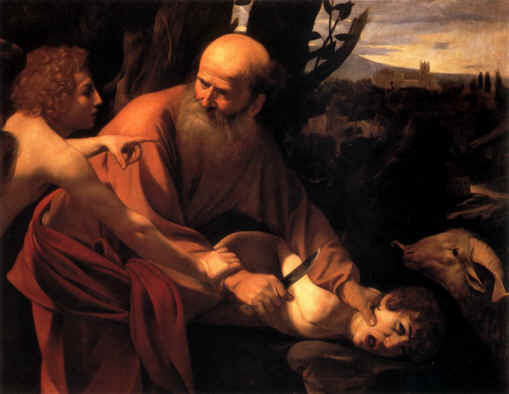 A few weeks ago, I had the privilege to hear a sermon about this biblical story. You know, the one where Abraham is out playing ball with his miracle child Isaac, and God shows up with some instructions:
"Abraham!"
"Here I am," he replied.
"Take your son, your only son, Isaac, whom you love, and go to the region of Moriah. Sacrifice him there as a burnt offering on one of the mountains I will tell you about."
Wait, what?
To his credit, the preacher mentioned that this story is a little problematic. Then he went on to extract the moral that we ought to loosen our grip on our ideas about ownership ... that we ought not be Consumers above all, and that we should be willing to give God whatever God demands. That bit of scolding was good for me, because the message about holding loosely to things and releasing my consumer identity is definitely a message I need to hear.
But this lukewarm approach to the story of Abraham and Isaac still strikes me as sort of ... how do I say this nicely? Morally deficient?
Bad?
Evil.
OK, so I'll grant that we shouldn't be all grabby about our possessions. Great. But it makes me a bit queasy to see Abraham held up as a paragon of virtue when he holds his morals so loosely that he's willing to stoop to human sacrifice. I mean, it's not like this is some abstract theological question about an event that could only happen in the context of a Middle Eastern sacrificial system. No, apparently people have to answer this question on a fairly regular basis. When the voice of God pops into your head and tells you to kill your children, what should you do?
I don't know how much theological arguments can influence people with schizophrenic disorders. Maybe not at all. But my answer to the question is: if that voice in your head tells you to do something evil, like murder your children, call "bullshit". You can be pretty sure that it's not the voice of God.
Oh, but what if God has changed her mind and decided that in this situation, it is actually good to kill your child!?
Bullshit.
Maybe God knows good and evil, but she doesn't make them out of thin air. Power does not imply goodness. Or in the words of T.H. White, might does not make right.
Therefore, if you're worshiping a God who obliterates entire races of people, and demands child sacrifice, and deceives his followers about the nature of good and evil, then you've been tricked. You aren't worshiping a good God, you're worshiping an evil spirit. And by worshiping it, you empower it. You are complicit in it. If it continues to hold sway over the earth, then to some small degree, it's your fault.
Ahem.
After the sermon ended, a husband and wife stood up to share some thoughts before the eucharist; in our tradition we call them "communion meditations". And while I wish they had said something different, I can't really blame them for what they did next. They began juxtaposing scriptures about the sacrifice of Isaac with scriptures about Jesus, implying that just as Abraham was willing to sacrifice Isaac to God, God was willing to sacrifice Jesus to God, so that our sins could be forgiven.
Like I said, I can't really blame them. The metaphor pops up in the text over and over again, and if somehow God can be good while also demanding child sacrifice, well then of course God can be good while demanding adult sacrifice. God can't just forgive the sins of the world, somehow reparation has to be made, God's wrath has to be "satisfied". Jesus has to be the perfect sacrificial lamb.
On my more generous days, when I read those things, I can imagine how they were helpful to someone. But the only people I can imagine who might have taken away more good than evil from those metaphors were premodern Jews, who had no inkling about the philosophies of liberal humanism, and whose worldview was steeped in blood and sacrificial mystery.
Premodern Jews.
Now I understand why the church spends so much time literally interpreting biblical stories, giving churchgoers background about the Jewish sacrificial system, praying for rain, disparaging other religions and allowing a tribal deity's murders and genocides to go unexamined. It's because almost all of its sacred texts were written for an audience of premodern Jews. The only way to make any sense of the Bible, really, is to squeeze one's postmodern, liberal humanist mind into a premodern, Jewish worldview. It's only then that the theology of penal substitutionary atonement can be self-evidently beautiful, and it's only then that we can ignore the dissonance between God's claims to be huge and eternal and God's apparent distaste for shrimp, polyester and homosexuals. It's only then that it makes sense to say "Jesus ascended into heaven" rather than "Jesus flew off into space".
Consequently, my current task at church has become translation. Maybe this has even become my approach to theology in general. How can we understand the Christian story -- what metaphors can we use -- that will make it powerful and engaging for people who haven't spent their whole lives training to be premodern Jews? More practically, how can I make it through a church service without being offended at the wicked, petty God that my fellow Christians worship?
It's a tricky proposition, and though I think I've come a long way in the past few years, I'm still hunting the used bookstores for a pocket dictionary translating between "postmodern liberal humanist" and "premodern Jew". Wish me luck.
Monday, October 08, 2007
Slashdot: God Box

Subscribe to:
Posts (Atom)
