Monday, February 27, 2006

Far out beyond our dreams

Dramatic tip o' the hat to Greg Kendall-Ball, who has linked us to a great article on the SoulForce site.

The article's author, Lewis B. Smedes, is a retired minister in the Christian Reformed tradition, and a former professor. In the article, Smedes asks an interesting question:

Was the church's embrace of people who were once divorced and are now living faithfully in second marriages a precedent for embracing homosexual people who live faithfully in covenanted partnerships?

In arguing that the two are similar, Smedes asks the following additional questions:

The first question is this: Is a partnership of two homosexual persons morally similar - in relevant ways - to the marriage of divorced and remarried heterosexual people?

The second question we must answer is this: Does the Bible's word about homosexuals lay down a rule for excluding partnered Christian homosexuals from the church's fellowship? Or does it witness to God's original intention for sexual orientation without laying down abiding rules for the church?

Smedes's arguments are interesting, and although I disagree with some of his conclusions, I think his approach to the text will speak clearly to some of my more conservative readers.

(Also, don't miss the opportunity to listen to Dr. Money's Chapel speech commenting on the upcoming Equality Ride visit ... the links are in the post below.)

Tuesday, February 21, 2006

President Money, in THX Surround Sound!

As people commented on my latest post about Equality Ride, an anonymous visitor (presumably from ACU) had some sharp criticisms:

After reading this post, I have to wonder if the author was actually in chapel on the day that Dr. Money spoke. There were equal amounts of clapping/cheering, if not more, when Dr. Money stated they would be welcoming SoulForce...

For those of you who feel that this is cool, that you're sad it didn't happen while you were at ACU, and for those who would like to be at ACU to see this...you have no idea what difficult decision this has been for the ACU administration and ACU community. The administration is completely aware of the "underground homosexuality" on campus and is completely aware that ACU had an SA president that is now "out." The bubble is not that thick. Instead of guessing at the facts surrounding these decisions, instead of wishing you were here during this trying time, instead of stating how you would handle these things differently, instead of saying you're dissappointed in the student body...I would encourage you to pray. Pray for those who are making the decisions about SoulForce. Pray for the "riders." Pray for the ACU administration and for the students, faculty, and staff on campus while this is going on. This is not easy, nor is it a show for the ammusement of bloggers.


The anonymous visitor makes a good observation: I was not at chapel on the day in question, so I received all of my information second-hand. My only information about that talk came from some (fairly reliable) students and staff members who were there.

So in the interest of clearing up this difference of perception, I managed to get a copy of Money's speech, clean up a little of the tape hiss, and convert it into a format you can download. So here's the clip of the audience responses to Money's speech, in MP3 format.

Chapel Clip
Jan 19, 2006 (MP3)


I've also converted the entire speech, so if you'd like more context, here it is.

Entire Chapel Address
Jan 19, 2006 (MP3)


After having listened to the clip, it seems that our visitor was at least partly right ... the second bit of clapping does seem to be as loud as the first. On the other hand, there were not equal amounts of cheering.

But either way, the version of events in my previous post was inaccurate. A lot of people did applaud president Money's announcement that we would not have the Equality Riders arrested. Thank you, anonymous visitor, for forcing me to clear that up.

On the other hand I am a bit perplexed about the second part of the anonymous visitor's comment, in which the visitor criticized those people who thought the Equality Ride visit was book. (That's "cool", for all you old folks.) In a following comment, I asked for clarification:

I'm sure that you're being completely sincere here, but I have to confess to a little skepticism because you don't give us any explanation. What makes this this such a "difficult decision" and a "trying time"?

I mean, after reading their Web site, and talking to an equality ride coordinator, it seems pretty clear that the riders won't be megaphone-toting belligerents. So it seems to me that in the interest of open discussion, administrators should simply welcome the riders and let them wander the campus. Then people can make their own decisions about whether ACU is upholding Christian values.

But maybe there's something I'm missing?


No clarification has been forthcoming, but I'm still hopeful.

Oh, and for those of you who are actually interested doing something: I'm also talking to some locals and ACU alums who want to make sure that the Equality Riders are greated warmly and taken seriously. The people I'm talking to have different opinions about whether homosexual behavior is displeasing to God, but they all agree that hospitality and openness are appropriate Christian responses. So check back here for updates on our plans, and leave me a comment if you're interested in being a part of this group.

Tuesday, February 07, 2006

Equality Ride

Ok, I've weighed in on the implications of the size of President Money's house. Now here's something else that ACU alums might find interesting.


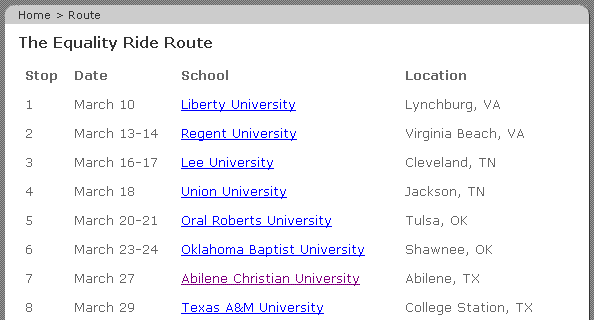
The Equality Ride is an event sponsored by Soulforce, a faith-based organization that promotes civil rights for gay, lesbian, bisexual and transgender people. The Equality Ride is meant to recall the freedom rides of the Civil Rights movement, and will consist of 30 young adults taking a bus tour of the U.S., periodically stopping at a university that has discriminates against students on the basis of their sexuality. When the bus arrives at a university, the riders will have press conferences, meetings and (in the case of Christian schools) Bible studies, all attempting to explain why they think the university's policies are wrong.

ACU administrators are well aware of the upcoming visit - in a recent Chapel talk, Dr. Money told students that the Equality Ride was coming, and he described how he thought ACU students, faculty and staff should behave. Unfortunately, Money and the student body seem to disagree on the proper way to handle the visitors.


MONEY: Now we could tell these people that they're not welcome on our campus, and when they show up, we could call the police and have them arrested.

[The audience cheers and applauds.]

MONEY: Um ... but ... that's not what we want to do.

[Silence. Then a few people clap. One voice yells, "Thank you!"]

Then Money goes on to describe how everyone should behave. (That's just an approximation of the talk, but I'm sure I got every third or fourth word right.)

So from what I hear, the Equality Riders will be allowed on campus, but their movements will be very tightly controlled. They will not be allowed to speak in Chapel, but they will meet with certain administrators. I don't know if they'll have any Bible studies or press conferences on campus, but I'm guessing they'll have a few off-campus.

Their technical gripe, by the way, is the section of the student manual that reads:

2. Section Two violations. These violations will result in a minimum disciplinary response of probation on the first occurrence or suspension/dismissal on the second occurrence, with additional conditions or alternative requirements. They include, but are not limited to, the following: ... 2-14. Cohabitation and/or sexual immorality, including homosexual behavior.


Homosexual behavior, of course, could include quite a bit more than extramarital homosexual sex ... although that's kind of a catch-22, because homosexual marriage is also illegal in Texas ... nevermind.

In general, though, I think the riders object to the theological position that homosexuality is a sin or psychological sickness. They claim that this position is false, but they also say that promoting this opinion fosters discrimination and prevents gay people from coming to terms with their sexual identity.

I'll be posting more about the equality ride in the coming weeks, but I'd kind of like to open the issue right now, and solicit comments from you reader-people. Feel free to say whatever you like. As long as it's not stupid.

Update: I apparently didn't finish that sentence about what they'll do when they arrive at a university. It's finished now.

Wednesday, January 18, 2006

Wave that Red Flag

For the last week or so, little red flags have been sprouting from the passenger-side windows of Abilene vehicles. At first I thought we had landed a major-league sports team. But today I noticed that the flags read "LIFE" in bold black letters.

Cool.

I mean, I can only assume that they're trying to raise funds to help preserve LIFE for hungry people, 24,000 of whom die every day. (thehungersite.com) Maybe they're going to start by trading in their $20,000 Honda Element for ... oh ... a $3000 Honda Civic.

I could be wrong, though. Maybe they're protesting the 2,100 American troops and 30,000 Iraqi civilians who have been killed in the latest Iraq war. (iraqbodycount.net) Maybe they're going to start by taking that wretched "dubya 2004" sticker off their rear window.

Whatever they're doing, I'm sure it's an honest attempt to help real, live people, not just an attempt to push a political agenda.

Wednesday, January 04, 2006

Book Review: The Scandal of the Evangelical Conscience, by Ronald J. Sider

Even before I read The Scandal of the Evangelical Conscience, I suspected that Evangelical Christians weren't particularly moral people. And the first chapter of Sider's book, "The Depth of the Scandal", goes a long way toward confirming my suspicions. Sider quotes statistics that paint a damning picture of Evangelicals, including their high rate of divorce, their appalling tendency toward abuse, and their disappointing attachment to money.

But even though I'm skeptical about the morality of Western Christians, I still have hope. Despite the Church's history of disappointing behavior, I still think Jesus had it right, and I still believe God has the power to turn sinners into saints. So after reading the first sad chapter, I hoped that Sider would share some bright examples, some lighthouses of Christian community and Christian morality.

I was disappointed.

Sider spends the rest of the book spinning his wheels, treating us to a dull 100 pages in which he insists that right doctrine, church discipline and small groups will turn the church around.

Now when it comes to contrasting the wealth of Christians with the poverty of the world at large, Sider is a refreshing respite from the ambivalence of most Evangelical preachers. In a particularly barbed passage, Sider writes, "Not one evangelical pastor in ten comes even close to talking as much about the poor as the Bible does."

But these bright spots are overshadowed by Sider's preoccupation with ineffective solutions and his odd pet issues, which pop up up so predictably that one begins to suspect that odd pet issues are a prerequisite to being an evangelical. Legislation is suggested as a way to create a more Christian nation. A biblical worldview is equated with traditional evangelical doctrine. The enlightenment, post-modernism, evolutionary theory and the occult are all fingered as hastening the downfall of Christian morality. And in one of the book's saddest passages, the racism that Sider decries is practically assumed:

Our people, especially congregational leaders, need to see poverty firsthand. Mission trips, either across town to spend a weekend with an African American or Latino congregation or to another country in Africa or Latin America, can be powerful change agents. (italics mine)

Sider would have ended up with a much better book if he had spent more time trying to understand the problem, and less time trying to mold his pet issues into a generic, whole-church solution. Instead, he spends the last three-quarters of the book chipping away at his own credibility, and by the book's end, the interesting and useful ideas in his first chapter have disappeared into a mess of orthodoxy and unlikely solutions.

Thursday, December 22, 2005

The Best Christmas Catalog Ever

Every year around Christmas time, we get a catalog from World Vision. We get a lot of other catalogs, but this one stands out. For one thing, the photography is really good. For another, the stuff they're selling is totally great.

See, this catalog isn't full of new TVs or cute sweaters or baby toys or new cars. It's full of things like this:

Sheep
$95


Sheep are known to "go astray", but they are always worth finding! For cold, hungry families, a sheep's wool provides soft, warm, and long-lasting clothes. Sheep often give birth to twins or triplets, which can be sold at the market. Your gift of a sheep provides comfort and warmth, extra money, and nourishment.


Eye Surgery
$560


This gift, given in your name through World Vision, will provide surgery to correct congenital blindness or vision impairment for a boy or girl in need. Soon, the eyes of a child in a country like Romania or Azerbaijan will literally be opened to the beauty of God's creation.


Now I don't know about you, but I think this catalog is a work of genius. I mean, it's pretty and the writing is nice, but the real power in it is that it forces our imagined altruism to go head-to-head with our consumerism. Once we've read this catalog, we can no longer tithe our tithe and do what we want with the rest of our money.

Thinking of buying yourself a few hardcover books? Instead, you could feed a village for a year.

Thinking of buying yourself a new computer? Instead, you could shell out that dough and help your son ... I mean, somebody else's son ... see a tree or a mountain or a ball for the very first time.

And the damage to our consumerism just keeps coming. The pictures in the catalog stick in our heads. So each time we think about spending a dollar on the movies or on a new car or on a fancy recliner, we're forced to consider what else we could be doing with the money ... and now that else includes feeding the hungry, clothing the naked and ... dear God ... giving sight to the blind.

(You can find the entire catalog here.)

Tuesday, December 20, 2005

Avatar Sneakiness

Today, I changed my Instant Messenger avatar - the little glyph that shows up when I send an annoying chat message. My avatar used to be the program icon for one of our pieces of software. Now it's a doodle I did in Microsoft Paint.


Pretty, huh? Before you go asking me what it is, take a minute to look at it again. What do you think it is?

Time's up! The answer is, it's a digital Ink Blot. You're supposed to tell me what you think it looks like, and I'm supposed to figure out what your interpretation tells me about the deep undercurrents of your psyche. Tricky, huh? A buddy icon generally gives you information about me ... it might tell you what I look like, or what cartoon characters I associate with, or how boring I am to choose a program icon. But this avatar works the other way around, and gives ME information about YOU! A testament to my own paranoia!

<insert diabolical laugh here>

Ok, so let's look at my first couple of victims and see how they respond. First, my unsuspecting wife.

vryhotwife: what's that icon next to your words?
studmffn: what's it look like?
vryhotwife: gray and white clouds. i can't see it very well.
studmffn: nod
studmffn: it's actually a kind of an ink blot
vryhotwife: hmmm.
studmffn: what you think it looks like is supposed to tell me things about you
vryhotwife: oh, and what did you learn?
studmffn: um
studmffn: i dunno
studmffn: what else do you think it looks like?
vryhotwife: um, a little bird smoking underneath a big tree trunk?
studmffn: now you're talkin'

Yes, she actually said "a little bird smoking underneath a big tree trunk". And no, those aren't our actual screen names.

I also got a good response from one of my work compadres:

reep: What is that?
studmffn: it's an inkblot
studmffn: sorta
studmffn: it tells me the deep secrets of all of my chatting buddiez
reep: Whew. I was getting nervous. It looked like a Communist Revolution to me.

Which, incidentally, reminds me of some scary things that have been in the news lately:

this (courtesy of reep, because I happen to own a copy of the Little Red Book, straight from the heart of Red China)
and this (courtesy of me, because the President is off his rocker)

But I guess it just goes to show: If you work for the gov'ment, you don't need inkblots. Heck, you don't even need checks and balances! And as reep pointed out: if the Prez is straight on this one, wouldn't it make Watergate legal?

Tuesday, December 13, 2005

Evolution and God's Love

Some Christians who reject evolutionary theory argue that it conflicts with their understanding of a loving God. Put simply, they think it would be unloving for God to create sentient life using such a wasteful process; one with so many "dead ends".

But this argument only holds if you think of evolution as a tool for creating homo sapiens. But what if you're a little more skeptical about the worth of human beings? I mean, we can be pretty nasty little organisms. And perhaps we too are a step in the evolutionary process. Maybe our current set of DNA has yet to be perfected, and God's Ultimate Creation is still waiting in the wings.

Given these uncertainties, it seems more convincing to argue that homo sapiens (while groovy) is not the only part of the creation that God really cares about. Instead of saying that evolution is wrong because it allows for "dead-end" species, we should say that God valued the extinct species just like he values their ancestors, and no part of the chain has been exempt from God's oversight and care.

Tuesday, November 29, 2005

Uses for Euphemism

It seems to me that if you want to do something nasty to another person, the easiest way to justify yourself is to not think about it at all. If your conscience starts to nag you, don't fight with it; just ignore it. Give it a zennish dismissal; tell yourself, "I'll have to think about that ... but later."

Of course, you can't always get away with this. Sometimes, obnoxious people will show up and ask you pointed questions about the nasty things you want to do. In this event, you can salvage your blissful ignorance by speaking abstractly. For a good example of this technique at work, listen to the following interview with Representative Thomas Tancredo (R-CO).

http://www.npr.org/templates/story/story.php?storyId=5029291

Tancredo thinks that we should pursue a stricter immigration strategy. First, we need to seal our southern border, and second, we need to deport the nearly 2 million illegal the illegal immigrants now living in the U.S. Wait, did I say 2 million? I meant 20 million. We need to deport the nearly 20 milion illegal immigrants now living in the U.S. Of course, Tancredo wisely avoids describing the situation this way:

ALEX CHADWICK: But aren't there millions of illegal immigrants currently residing in this country? What are you going to do with all those people?

REP. TANCREDO: The most conservative estimate I have ever heard is 13 million, but I, I think it's much closer to even 20 million people who are here illegally. And what are you going to do? You're going to enforce the law.

Pure genius! What sleight of hand! Notice how deftly Tancredo points us toward the black-and-white world of legality, drawing our attention away from the ethical messiness that we might otherwise have to deal with. Obviously, says Tancredo, the only question here is whether or not the law should be enforced. And of course the law should be enforced! Case closed!

But Chadwick was asking about about people. And while it's easy to agree with a generic "we should enforce the laws", it's a bit more difficult to agree with, "we should hunt down 20 million people, uproot them from their homes and send them back to whichever third-world nation they came from." It's even more difficult to say, "we should arrest my neighbor Joe and his wife Alma, evict them from their house, and ship their entire family back to Panama." Therefore, if you want to protect the borders of the United States of America, you shouldn't start thinking about these real people. Instead, speak in abstractions. It's much easier that way.

Monday, November 14, 2005

An Odd Sort of Argument

Well, Texans did even worse than I expected, voting nearly 75% to 25% to approve a the Texas constitutional amendment to ban nontraditonal marriage. This is too bad, because:

1. The amendment is redundant, because Texas already has laws prohibiting gay marriage. But our representatives obviously don't have enough work to justify their paychecks, so they resort to passing laws about cheerleading and other unnecessary legislation.

2. The amendment denies legal, emotional and perhaps even the spiritual benefits of marriage to a long-ostracized minority group. For many voters, I suppose this outcome was just what they had in mind. That doesn't make their behavior any more ethical, or any less harmful.

3. God thinks that, all things considered, gay marriage is OK.

Statement #3 is simply a summary of what I think God thinks about gay marriage, which arises from an aggregation of the following experiences:

1. My upbringing in the church, which included lots of Bible reading. This means I have a good idea about what's actually in there, and what's not.

(An aside, here: please don't expect me to take seriously your comments about scripture if you haven't at least read the entire Bible. I consider that a minimal standard for competent discussion.)

2. Masters of Divinity friends discussing good ways and bad ways of interpreting the Bible.

3. Discussions with helpful acquaintances who considered themselves gay or lesbian.

4. A few years spent attempting to empathize with other people.

5. A few years spent thinking about suffering (disease, famine, natural disaster, pogroms, abuse, depression, post-nasal drip) and the way God interacts with the world.

6. A few years spent attempting to ask questions clearly and answer them precisely.

These ideas and experiences have lead me to the conclusion expressed concisely in statement #3: God thinks gay marriage isn't such a big deal. To support statement 3, I suppose I could provide a well-reasoned analysis of the Bible and the world, trying to prove that God thinks one way or another. This is probably what Paul was expecting when he once asked me to post on the topic of homosexuality. But in my experience, this sort of analysis isn't helpful unless you and the other party have spent some time trying to understand the history of thought that underpins your reasoning.

So here's my invitation to you. If you can spare a few brainwaves, take some time to think about God and gay marriage, and then take a few minutes to write a brief post for the rest of us. But don't just share your reasoning in this post; also summarize the experiences that make your belief ring true.

Monday, November 07, 2005

Election Tuesday Nov. 8

Just a friendly reminder to you Texans: This tuesday, you can vote on the proposed amendments to the Texas constitution.

My advice: if you want to give the thumbs-down to prop. 2, get out there and vote.

On the other hand, if you want to give the thumbs up to prop 2., first visit Liberty and Servanthood, Jeff Wilhite's blog. One of his recent posts gives some good reasons that social onservatives should vote against proposition 2.

If you read Jeff's post and you're still not convinced, just stay home on Tuesday. I mean, you're probably tired, right? I bet you've been working hard every day to defend the institution of marriage. You deserve a break.

Friday, November 04, 2005

Diablog Shelved

Just wanted to let you know that I've removed the Diablog links from my blog. I hadn't been able to give much time to developing it, and there didn't seem to be much interest in using it.

But if I'm wrong, and you're still interested in using Diablog or testing it, holler.

Friday, October 28, 2005

In Context

Here's something amusing. Hop on over to Bible Gateway and search the bible for something. "Poor", for example.

Now examine your results, which are broken up by individual scripture. There are three links for each scripture: one that will only show you the single scripture, one that will also show you the preceding and following verses ("in context"), and one that will show you the entire chapter ("whole chapter").

I like Bible Gateway. It's handy for finding things, it looks nice, and it's free. But there seems to be something fundamentally wrong with their labeling. Since when is three Bible verses "in context"? I mean, check out these three verses:

16 "They were the ones who followed Balaam's advice and were the means of turning the Israelites away from the LORD in what happened at Peor, so that a plague struck the LORD's people. 17 Now kill all the boys. And kill every woman who has slept with a man, 18 but save for yourselves every girl who has never slept with a man.

Now if you didn't know what was going on in the passage from Numbers, you might think that God was telling the Israelites to massacre a bunch of people, except of course the pretty young virgins. But if you read the entire chapter, you realize that the passage is actually saying that ... um ... God told the Israelites to massacre a bunch of people, except of course the pretty young virgins.

Nevermind. Bad example. We'll talk about interpreting the Old Testament another time.

What I meant to say was, when it comes to interpreting things, three verses aren't much different than one verse. Three verses certainly aren't going to give you any idea about what the author is trying to do in the book at large. The Entire Chapter may not even give you that.

So to be more accurate, I suggest that the Bible Gateway people change their labels to the following:

1 verse:
Prooftexters Click Here!!

3 verses:
Southern Baptists Click Here!!

Entire Chapter:

Suck It Up And Read the Book, Willya?

For more amusement, those of you who searched for "poor" should notice the number of results that returned, and then do a search for "homosexual".

Wednesday, October 19, 2005

Proposition 2

For those of you who aren't aware, there's a special election in Texas this November. One of the items on the ballot is a so-called "protection of marriage" amendment. Just wanted to share some of the reasons that this is a bad idea.

1. Amending the Texas constitution is unnecessary.

Texas already has laws prohibiting same-sex marriages. An amendment would add to the number of laws in Texas without adding to their substance. If legislators expected these laws to be overturned because they are discriminatory, a constitutional amendment might be effective. However, based on the fact that every member on the Texas Supreme Court is elected, and every one is also a Republican, an amendment is unnecessary.

2. Amending the Texas constitution will not help defend the sanctity of marriage.

As described by the Texas Legislative Council: "If the purpose of the proposed amendment is to defend the sanctity of marriage, that purpose would be better served by state laws addressing the high incidences of divorce, adultery, and family violence that occur within traditional marriage between a man and a woman and that are more damaging to the institution of marriage, the welfare of children, and the stability of society, than same-sex marriages."

3. The imprecise wording of this amendment will have unintended consequences for women and children.

For example, it will reduce protectections against domestic violence for women and children in common-law marriages. (This is because of the section establishing that the state and its political subdivisions could not create or recognize any legal status identical to or similar to marriage.)

4. I don't think the following argument would convince my conservative co-workers, but this sort of amendment clearly discriminates against gay and lesbian couples.

That's why other states have overturned laws banning same-sex marriages: courts have ruled that the equal rights sections of their constitutions conflict with such laws. If you doubt that having your marriage recognized by the state confers any benefits or rights, visit this site and have a read.

The Texas Secretary of State's website contains more information about *all* the propositions in the November election, as well as arguments for and against.

Thursday, October 13, 2005

For Shame

Wow. A month and a day since my last post. If anyone's still visiting, I beg your forgiveness.

I also haven't read any blogs for the past month, and I haven't done any work on diablog. Instead, I've been trying to start a little side business. Between that and the time spent playing with my crazy baby (who is 9 months old today), my blog has fallen into disrepair.

I'm not sure if the business is going to go or not, but once I get things started I'll see if I can't get this old blog juiced up again.

Monday, September 12, 2005

Let's Hear a Hearing

Currently, we have Senators pontificating about the role of the Supreme Court.

Listen.

I suspect Roberts is going to be confirmed without much trouble, so the questioning is probably the most telling part of this whole process.

Got to disagree with Kennedy somewhat. To some degree, interpretation of the existing constitution is important.

Hm. John Cornyn isn't so bright.

Expanding freedom. Hm. That seems reasonable.

Judicial activism? I think I'd be more inclined to attribute the polarization of American politics to ... oh ... the marriage of the Republican party and the Religious Right.

...ah, let's see what Roberts says.

- He says that a judge is like an umpire ... interpreting the laws, not creating them.

- Judges have to be humble and listen to the opinions of their colleagues.

- Wow. Beautiful description of the Rule of Law.

- More baseball imagery.

- Ends up with two commitments: 1) to be judicially modest 2) to defend the independence of the court.

- 6 minutes. Succinct. No wonder this guy was a spectacular lawyer.

Sunday, September 11, 2005

Another Good Sermon

... although this one has a bit more cursing.

The coolness of the hushed church, the smell of incense lingering in the air, envelops me. I gaze down the length of the church and fixate on the tabernacle. The place where, when I was little, I believed God lived. I haven’t sat in a church in a long time. My mind is a sickened blank. What to say? What to ask the Almighty?

Almighty my ass. What a sick joke. When was the last time He saved anybody?

If you're game, visit waiterrant and read The God who Drowns. Thanks to Stu for the heads-up.

Oh, and I think the diablog engine is about ready for other people to try out on their blogs. I mean, it compiles and it's not trying to write 1 gig files anymore, so I figure it's pretty safe.

The links in my sidebar should subscribe you to all posts (instead of just one). Give it a whirl.

Thursday, September 08, 2005

Curse You, Internet Explorer

Yes, Diablog is broken in IE.

I'm fixing it.

More Stuff by Other People

When things are going badly, it's hard to know what to say about God. Most of the time, I have the luxury of not having to say anything. But some people don't have that luxury: They have to get up and preach a sermon every Sunday. Katherine Torrance is one of these people.

In between our fits of praying and our acts of giving, we also have another task at hand: the important practice of trying to understand the events through the lens of our faith. There are questions to ask—the kinds of questions that don’t easily lend themselves to answers. Why do things like this happen? Why do some people survive and others perish? Does God have a role in natural disasters like hurricanes?

Visit Katherine's blog
to read the entire sermon.

Wednesday, September 07, 2005

Neck of an Hourglass

In the Gospels Jesus is asked 183 questions directly or indirectly. Of these, he directly answers three! Jesus’ idea of church is not about giving people answers but, in fact, leading them into liminal and dark space, where they will long and yearn for God, for wisdom and for their own souls.


As long as I'm not writing anything but software, I may as well pass along something interesting and readable.

The above quote is from Forty Years in a Narrow Space, by Len Hjalmarson. I originally found this piece with a little help from Grumblefish.